

Give your agentic chatbots a fast and reliable long-term memory
Key Takeaways
- A polyglot storage strategy matches data "temperature" to the right tool — optimizing both performance and cost.
- Redis holds hot context with sub-millisecond latency for natural conversation flow.
- Bigtable is the durable system of record for write-heavy history, kept lean with garbage-collection policies.
- BigQuery powers long-term analytics — sentiment and trend reporting without impacting the live chat.
- Store artifacts in Cloud Storage and keep only URI pointers plus signed URLs in your databases.
Scaling agentic chatbots to millions of users comes down to the data layer: you need fast context updates for real-time chat and efficient retrieval for long-term history. A polyglot architecture solves both — Redis for sub-millisecond hot context, Bigtable as the durable system of record, and BigQuery for archival analytics — so your agent stays coherent from the newest message to months-old archives. This is the same continuity that keeps a production agentic SDR coherent across long, multi-touch conversations.
When scaling conversational agents, the data layer design often determines success or failure. To support millions of users, agents need conversational continuity—the ability to maintain responsive chats while preserving the deep context that backend models require to remain coherent.
In this article, we explore how to use Google Cloud solutions to solve two primary data challenges in AI: fast context updates for real-time interaction and efficient retrieval for long-term history. We’ll dive into a polyglot approach using Redis, Bigtable, and BigQuery that ensures your agent retains detail from recent interactions to months-old archives.
What is the polyglot storage strategy?
What is a polyglot approach?
A polyglot approach uses a multi-tiered storage strategy, leveraging specialized data services rather than a single database to manage different data lifecycles. By matching the "temperature" and volume of data to the right tool—such as in-memory caches for speed and data warehouses for analytics—you optimize both performance and cost.
How do you define the memory tiers on Google Cloud?
To maintain continuity, we categorize memory into three distinct tiers:
- Short-term: Sub-millisecond "hot" context retrieval.
- Mid-term: Petabyte-scale durable system of record.
- Long-term: Archival and analytical insights.
How does short-term memory work with Memorystore for Redis?
Users expect chat histories to load instantaneously. For the immediate context of a conversation, Memorystore for Redis serves as the primary cache.
- The Benefit: As a fully managed in-memory store, it provides the sub-millisecond latency required for a natural conversational flow.
- The Implementation: Since chat sessions are incrementally growing lists, we use Redis Lists. By utilizing the native RPUSH command, the application transmits only the newest message, avoiding the network-heavy "read-modify-write" cycles common in simpler stores.
How does mid-term memory work with Cloud Bigtable?
As conversations grow, agentic applications need a durable, scalable home for history. Cloud Bigtable acts as the definitive system of record.
- The Scale: Bigtable is a NoSQL database designed for high-velocity, write-heavy workloads—perfect for millions of simultaneous interactions.
- Storage Optimization: Keep your active cluster lean by implementing garbage collection policies (e.g., retaining only the last 60 days in the high-performance tier).
- Key Strategy: Use a user_id#session_id#reverse_timestamp pattern. This co-locates messages from a single session, allowing for efficient range scans to retrieve history reloads quickly.
How does long-term memory and analytics work with BigQuery?
For archival and intelligence, data moves to BigQuery. While Bigtable serves the live app, BigQuery is designed for complex SQL queries at scale.
- The Feedback Loop: This operational data becomes a goldmine for improving user experience. You can run sentiment analysis or trend reporting without impacting the performance of the user-facing chat components.
How do you handle artifact storage with Cloud Storage (GCS)?
Unstructured data—like images uploaded for analysis or AI-generated documents—lives in Cloud Storage.
- Pointer Strategy: Redis and Bigtable records store a URI pointer (e.g., gs://bucket/file) rather than the raw binary data.
- Security: Serve files using signed URLs, providing time-limited access to the client without exposing your buckets publicly.
What is the hybrid sync-async strategy for data flow?
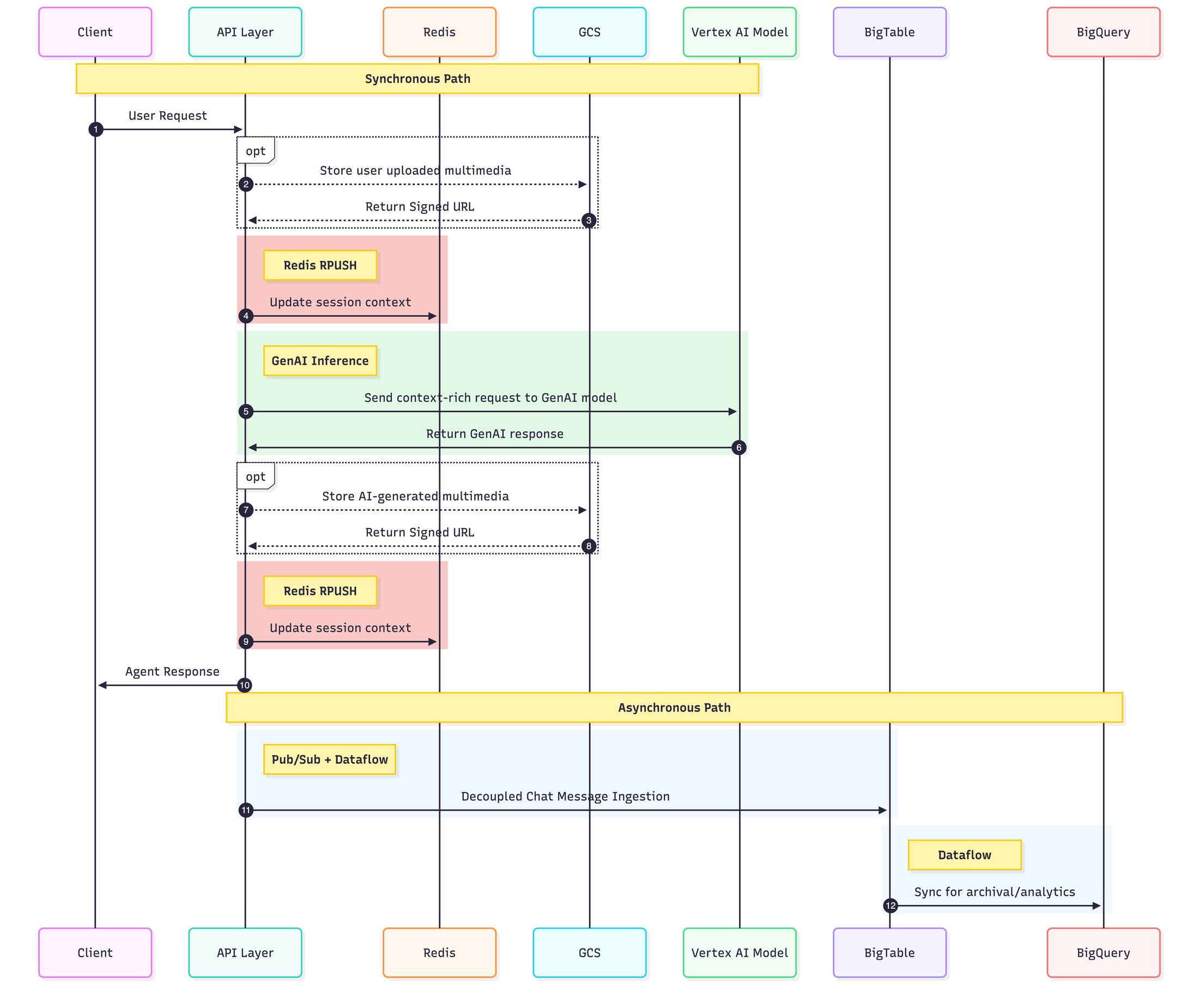
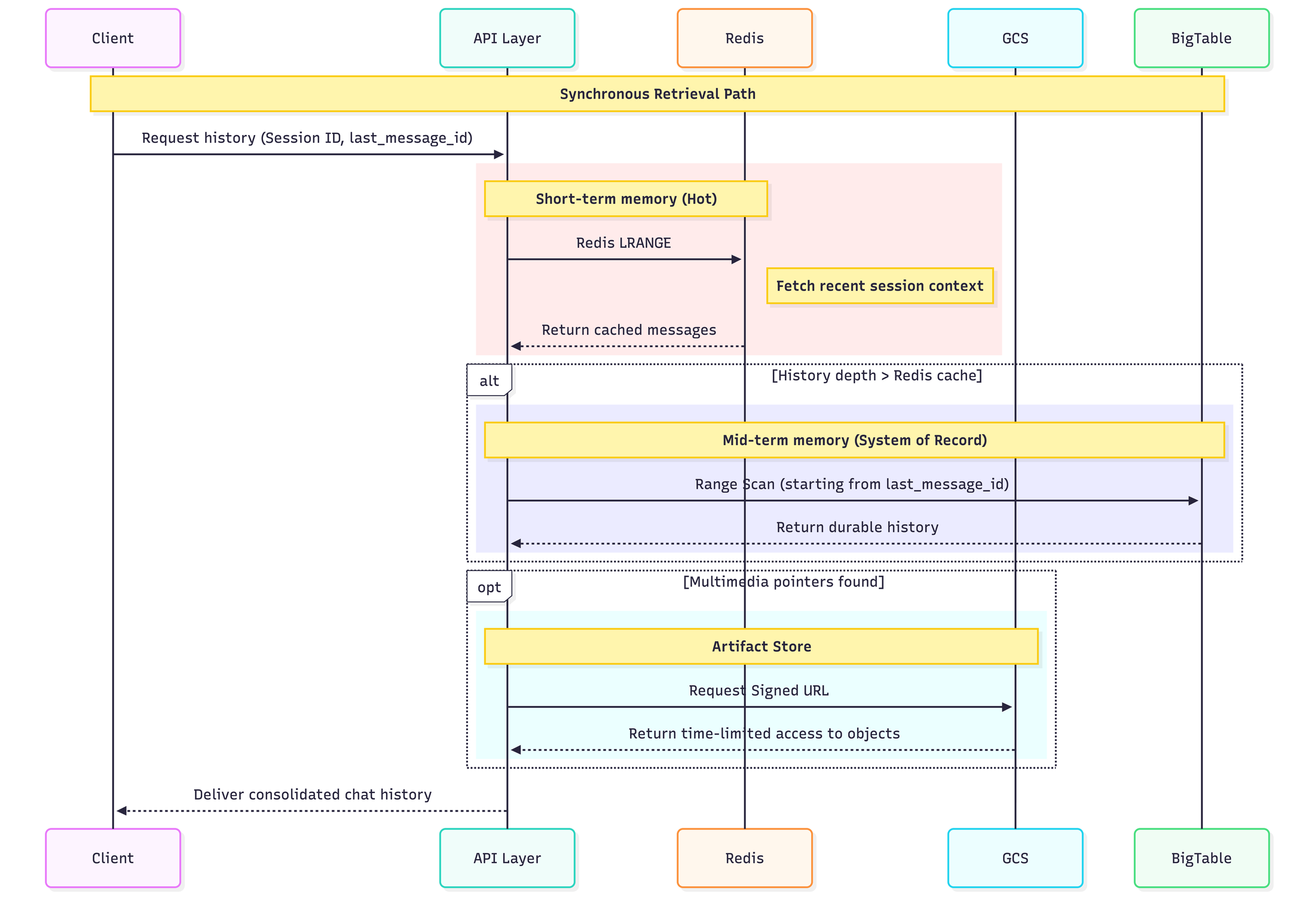
As shown in the sequence diagrams below, the hybrid sync-async strategy utilizes the abovementioned storage solutions to balance high-speed consistency with durable data persistence.
The diagram below shows how a user message and corresponding agent response traverse through the architecture:
The diagram below shows how data flows across the architecture when a user decides to retrieve chat history for a particular session:
Start building now
Ready to build an agent with a robust persistence layer?
- Build agents quickly: Start prototyping your agentic workflows on Vertex AI Agent Builder.
- Configure your cache: Determine which Memorystore for Redis configuration best suits your latency and availability needs.
- Design a robust BigTable schema: Review the schema design best practices.
- Bridge to analytics: Use the Bigtable change stream to BigQuery template to ready your live chat logs for actionable business insights.
- Bring data to life with analytics: UseLooker Conversational Analytics to drive product decisions through business intelligence.
A robust memory layer like this is what lets an agent stay coherent over long, high-volume conversations — the same foundation behind our production agentic SDR. If you'd rather deploy a memory-backed agent than build the data layer yourself, talk to our team.
Source Link:Give your agentic chatbots a fast and reliable long-term memory
This article was written from Google Cloud and originally published here.
Frequently Asked Questions
Find the answers here to your most pressing questions.
Latency and cost. Redis provides sub-millisecond response times for "hot" chat context, which is essential for natural conversation flow. Bigtable is fast, but it is optimized for high-throughput writes and petabyte-scale storage rather than the ultra-low latency required for per-message retrieval.
Use Garbage Collection (GC) policies. You can set rules to automatically delete messages older than a specific age — for example 60 days — or keep only a fixed number of recent messages per session. This keeps your mid-term memory lean and performant.
It enables efficient range scans. Since Bigtable sorts keys lexicographically, a reverse timestamp ensures the most recent messages are stored first, so your app can pull the last 10 messages instantly without scanning the entire session history.
No. Large binary objects degrade performance in NoSQL databases. Use a pointer strategy: upload the file to Cloud Storage and store only the URI in Bigtable, then use signed URLs to give the user temporary, secure access.
Use the Bigtable Change Streams to BigQuery template. This managed Dataflow pipeline automatically captures every new message written to Bigtable and streams it into BigQuery in real time, enabling immediate analytical insights without manual exports.